
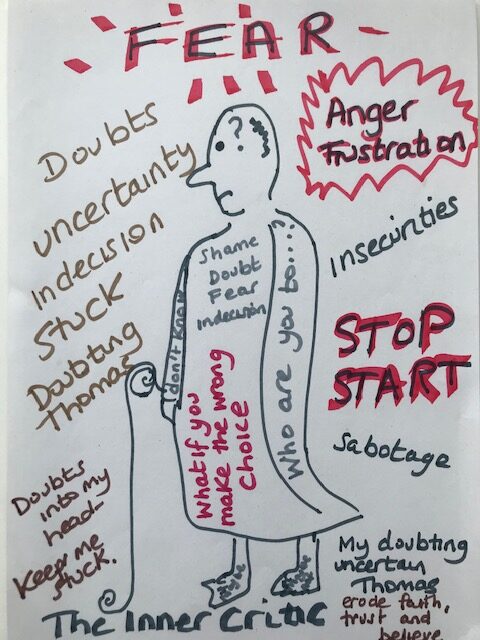
Creative Ways to Face Fear: Activities, Journal Prompts and Exercises
Fear is a natural human response to perceived danger, but it can also hold us back from pursuing our dreams and living fulfilling lives.
Fortunately, there are many creative ways to face fear, and turn it into a source of strength and inspiration.
In this blog post, I will share quotes, journal prompts, strategies, tools, exercises, and creative practices to help you creatively face fear and cultivate courage.
Fear is a normal and inevitable part of life.
We can’t eradicate it.

Working creatively with clients during therapy can be powerful, because word alone are not always enough.
Creativity helps to bring the unconscious, conscious.
Here is an example of how creative therapy can create positive change.

Creative Ways to Face Fear – Using Creativity in Therapy
Jane had been struggling with anxiety and panic attacks for years. Traditional therapy and medication hadn’t provided the relief she was seeking.
One day, she decided to try a more creative approach and began to draw her fears. At first, she found it difficult to put her fears onto paper, but soon she began to personify her anxiety and visualize it as a monster with sharp teeth and a fierce growl.
As she continued to draw and personify her anxiety, she found that she was able to confront it in a new way. Rather than feeling overwhelmed by her fear, she could see it as a separate entity that she could start to face and overcome.
She began to develop tools to manage her anxiety, such as deep breathing and visualization exercises, that helped her feel more in control.
Another great tool to help understand and manage fear it it journal and free-write.

Creative Journal Prompts to Face Fear
- What is one thing you’re afraid of? Why does it scare you?
- How has fear held you back in the past? What could you have done differently?
- What would you do if you weren’t afraid? What’s holding you back?
Here are some questions that can help you creatively face and deal with fear:
- What is my biggest fear?
- When have I faced my fears in the past? What was the outcome?
- What would I do if I weren’t afraid?
- What do I need to let go of in order to move forward?
- What would happen if I faced my fear and failed? How would I handle it?
- What is the worst-case scenario if I don’t face my fear?
- What is the best-case scenario if I do face my fear?
- What would I tell a friend who was facing the same fear?
- What limiting beliefs do I have about myself that are holding me back from facing my fear?
- What strengths do I have that can help me face my fear?
Here are some additional prompts that can help you identify, face, explore, and transform your fears:

- Name your fears.
- Explore the origin of your fear.
- Imagine your life without fear.
- What are the benefits of facing your fear?
- What steps can you take to face your fear?
- Who can support you in facing your fear?
- What is the first step you can take today to face your fear?
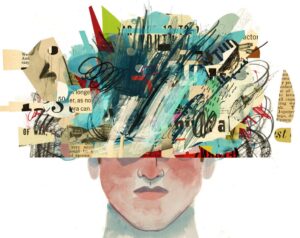
Strategies and Tools to Overcome Fear
Visualization: Picture yourself successfully facing your fear and imagine how you’ll feel afterwards.
Visualization is a powerful tool that can help us confront our fears and imagine a positive outcome. To practice visualization, find a quiet and comfortable place where you won’t be interrupted. Close your eyes and take several deep breaths, allowing your body to relax and your mind to focus.
Once you feel calm and centred, imagine yourself successfully facing your fear. Visualize the situation in as much detail as possible – what does it look like, sound like, and feel like? Imagine yourself feeling confident, strong, and capable as you confront your fear.
Focus on the positive emotions that you would feel after successfully facing your fear – relief, pride, and a sense of accomplishment. Allow yourself to fully experience these emotions in your visualization.
Take a few more deep breaths, and then slowly open your eyes. Reflect on your visualization and the positive emotions it brought up. This exercise can be repeated as often as necessary, and can be a helpful tool in building confidence and courage when facing fears.
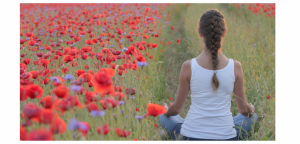
Mindfulness: Pay attention to your thoughts and feelings without judgment, and practice self-compassion.
One mindfulness exercise that can help manage and face fears is the Body Scan. The Body Scan involves lying down comfortably and slowly bringing awareness to each part of your body, starting from the toes and moving up to the head.
As you scan each body part, notice any sensations, tensions, or discomfort without judgment. Acknowledge any fearful thoughts or emotions that arise, but don’t dwell on them. Instead, focus on your breath and the physical sensations in each body part.
The Body Scan can help you become more aware of the physical sensations that accompany fear, such as tension in the chest or stomach. By practicing the Body Scan regularly, you can learn to recognize and release physical tension in the body, which can help reduce anxiety and fear.

Creative Practices to Cultivate Courage
- Creative writing: Write a story or poem about facing your fear, or use writing prompts to explore your emotions.
- Artistic expression: Draw, paint, or create something that represents your fear or your journey to overcome it.
- Movement: Dance, practice yoga, or engage in another form of physical expression to release tension and build confidence.
- Meditation: Use guided meditations to focus on self-love, courage, and gratitude.

Call to Action
Fear is a common human experience, but it doesn’t have to hold us back. By exploring our fears creatively and cultivating courage, we can live more fulfilling and meaningful lives.
So take a step today, no matter how small, towards facing your fear and embracing your own creative courage.
Talk to someone: Share your fears with a trusted friend, family member, or therapist.
Exposure therapy: Gradually expose yourself to the thing you’re afraid of in a safe and supportive environment.
Take a look at my previous blog post, Creative Ways to Get Motivated.
I love a good Ted Talk. This one is about what fear teaches us.